
BPI Urges AI Bank-Access Restrictions as Stripe Reports Nearly 80-Fold Wallet Spending Growth
Nov. 22, 2026 • Article • AI in Fintech
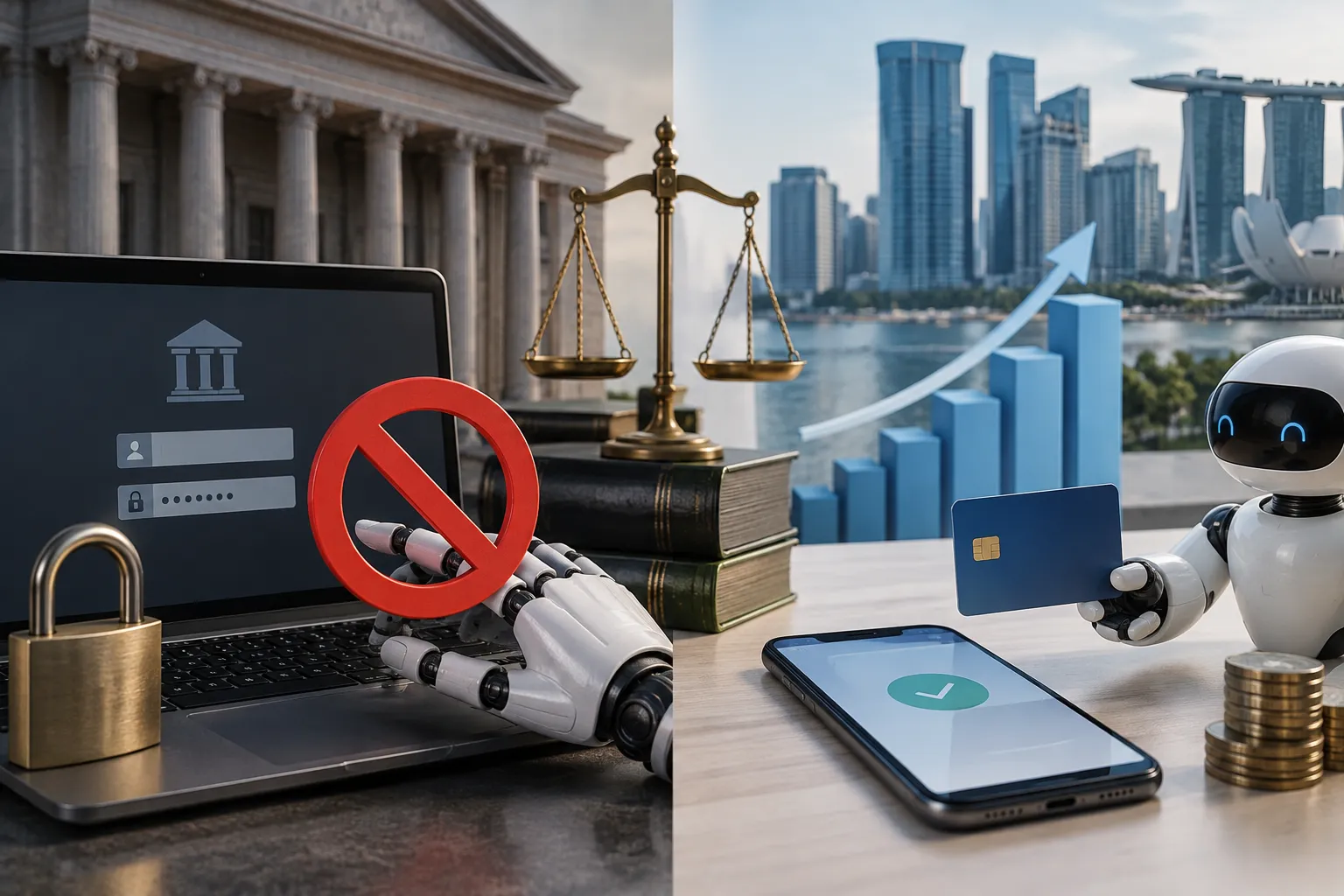
The Bank Policy Institute renewed its warning on November 21, 2026, that banks should block AI agents accessing customer accounts through unapproved channels. Separately, Stripe reported that the seven-day rolling average of daily spending through Link Agent Wallet rose nearly 80-fold between early September and mid-November. The figures exclude absolute spending totals and transaction counts, limiting conclusions about market scale. The two developments concern different access models: BPI focuses on agents using shared bank-login credentials, while Stripe’s wallet supplies limited payment credentials following customer approval. Banks’ responses also vary, with restrictions on outside agents coexisting with approved data-sharing arrangements and monitoring. Liability remains unsettled, despite changing bank agreements and developers’ disclaimers. FedScoop reported that Treasury nominee Rebekah Jurata declined to assign responsibility for a rogue agent’s unauthorized transfer. Singapore is meanwhile planning agent-verification and payment-sandbox initiatives to test safeguards for agent payments.

AI agent payments let software make purchases or initiate financial transfers on behalf of consumers and businesses. The central challenge is not simply enabling an agent to pay: it is proving who authorised the action, what limits applied and whether the resulting transaction followed those instructions. Emerging approaches combine signed mandates, agent-specific payment tokens, identity registries and spending controls. Different implementations offer different degrees of autonomy. Some capture permission before an agent shops; others isolate funds in a separate wallet and require confirmation for every payment. Business applications extend to procurement, digital-service purchases and experimental treasury workflows using programmable money. These controls can reduce credential exposure and create evidence for disputes, but they cannot guarantee that an agent selects the right product. Nor do they automatically settle liability. Consumer protection, authentication requirements, merchant acceptance and competing technical standards remain important constraints, while demonstrations and sandboxes should not be confused with widespread deployment.
The Bank Policy Institute renewed its warning on November 21, 2026, that banks should block AI agents accessing customer accounts through unapproved channels. Separately, Stripe reported that the seven-day rolling average of daily spending through Link Agent Wallet rose nearly 80-fold between early September and mid-November. The figures exclude absolute spending totals and transaction counts, limiting conclusions about market scale. The two developments concern different access models: BPI focuses on agents using shared bank-login credentials, while Stripe’s wallet supplies limited payment credentials following customer approval. Banks’ responses also vary, with restrictions on outside agents coexisting with approved data-sharing arrangements and monitoring. Liability remains unsettled, despite changing bank agreements and developers’ disclaimers. FedScoop reported that Treasury nominee Rebekah Jurata declined to assign responsibility for a rogue agent’s unauthorized transfer. Singapore is meanwhile planning agent-verification and payment-sandbox initiatives to test safeguards for agent payments.
Major U.S. banks are warning customers that granting third-party AI agents access to financial accounts could leave them responsible for resulting transactions, errors and security losses. TechCrunch reported on November 18, 2026 that Citibank updated its agreement, while PNC and Citizens issued similar terms or warnings. The measures follow Federal Reserve Governor Michael S. Barr’s warning that banks cannot always verify agents’ authenticity, consent or adherence to customer instructions. Those contractual positions do not settle whether consumer-protection laws permit banks to transfer every loss to customers. Legal and banking-policy analysts identify unresolved questions around software delegation, unintended payments and compromised agents. Meanwhile, Visa and Mastercard are expanding agentic commerce initiatives designed to document authorization and constrain spending. UK regulatory proposals and industry authentication work remain in development, leaving a gap between commercial deployment and clear rules for determining responsibility when an autonomous payment goes wrong.

The Monetary Authority of Singapore has outlined plans for an Agentic Money Sandbox alongside a PayNow Generation 2 roadmap, pairing controlled tests of AI-directed transactions with retail payment upgrades. The Future of Finance Institute will establish the sandbox, initially covering corporate treasury management using tokenised deposits and customer payments using tokenised deposits or stablecoins. At the Singapore FinTech Festival 2026, MAS officials emphasised that agents must operate within defined mandates, with institutions retaining accountability. Planned safeguards include a know-your-agent protocol and checks that can approve, escalate or reject proposed actions before execution. PayNow Gen2 enhancements will arrive progressively across 2027 and 2028, including e-commerce deep-linking infrastructure, structured payment data and merchant dispute rules. MAS will also coordinate exploratory work on high-frequency micropayments and agentic commerce. The initiatives remain distinct from separate wholesale central bank digital currency settlement tests, rather than constituting a single live autonomous payment system.

Visa has expanded Agentic Ready to the acceptance side of payments, bringing more than 140 initial participants into a framework for testing AI agent-led shopping and checkout. Payment providers, acquirers and business-to-business platforms join more than 175 issuers enrolled across 45 markets. The expansion includes more than 50 acceptance participants in Asia Pacific. The program assesses readiness across merchant access, product discovery, payment and post-purchase processes. It is not a general commercial rollout: Visa has disclosed neither a timetable for participants to move into live acceptance nor transaction volumes. Its approach adds authentication and transaction-linking tools to existing card infrastructure, but technical verification does not settle every liability question. Visa’s rules assign cardholders responsibility for actions by an Agentic Payment Provider, while an acquirer survey identifies liability redesign as the leading barrier to scaling. Further participants are expected to onboard through 2027.
OpenAI launched ChatGPT Wallet on November 13, 2026, with American Express, Mastercard and Visa. It allows AI agents to complete merchant web checkouts using tokenized card credentials, but requires the customer to review and biometrically approve each purchase. The launch brings a central question in agentic commerce into focus: how can payment systems establish what a shopper authorized, rather than merely verify that a transaction passed authentication? Mastercard and Google’s Verifiable Intent specification links identity, spending constraints and transaction outcomes in a cryptographic record. Visa’s Trusted Agent Protocol focuses on helping merchants identify legitimate shopping agents, while Mastercard has also tested tools to distinguish agent activity from bot fraud. Those measures address different parts of the trust problem, but they do not settle who bears a loss when an authenticated agent makes a mistaken purchase. Existing card dispute categories do not specifically address AI execution errors.